
Parker Hansen · 13 September 2026
Pollen Records from Arkpath Illuminate Prehistoric Vegetation Patterns
Pollen records extracted from sediment cores at Arkpath provide detailed evidence of vegetation changes across multiple prehistoric periods, and researchers continue to analyze these samples to map shifts in plant communities over thousands of years. The site yields continuous sequences that span the late Pleistocene into the Holocene, while lab processing separates pollen grains by type and counts them against reference collections from modern ecosystems.
Core extraction involves drilling through stratified deposits where organic material accumulates in layers, and each centimeter corresponds to a specific time interval determined through radiocarbon dating combined with stratigraphic correlation. Analysts identify taxa such as Pinus, Quercus, Betula, and various herbaceous species, then compile percentage diagrams that reveal dominance patterns at different depths.
Methods Behind the Analysis
Standard palynological preparation includes chemical digestion to remove carbonates, silicates, and humic acids, after which acetolysis concentrates the resistant pollen exines for microscopic examination. Technicians mount residues on slides and tally at least 300 grains per sample to achieve statistical reliability, while software packages calculate influx rates when sediment accumulation data are available. Multiple cores from different locations within the Arkpath basin allow cross-validation of trends and reduce local bias from single depositional settings.
Researchers integrate these counts with loss-on-ignition measurements that track organic content and with magnetic susceptibility readings that indicate erosion episodes. Such multiproxy approaches strengthen interpretations because pollen alone can be influenced by production rates and transport distances, whereas supporting indicators help isolate climate-driven vegetation responses from other factors.
Key Patterns in the Record
Data show an initial dominance of open steppe-tundra vegetation during colder intervals, followed by gradual expansion of boreal forest taxa as temperatures rose. Around the transition to the Holocene, deciduous elements increase while conifer percentages decline, and this sequence aligns with broader European records yet includes local nuances tied to topography and soil development at the Arkpath location.
Intervals of reduced arboreal pollen coincide with higher charcoal concentrations, suggesting periodic fire activity that maintained grassland patches within forested landscapes. These episodes appear at roughly millennial scales and correlate with independent proxy evidence for drier conditions derived from oxygen isotope ratios in nearby speleothems.
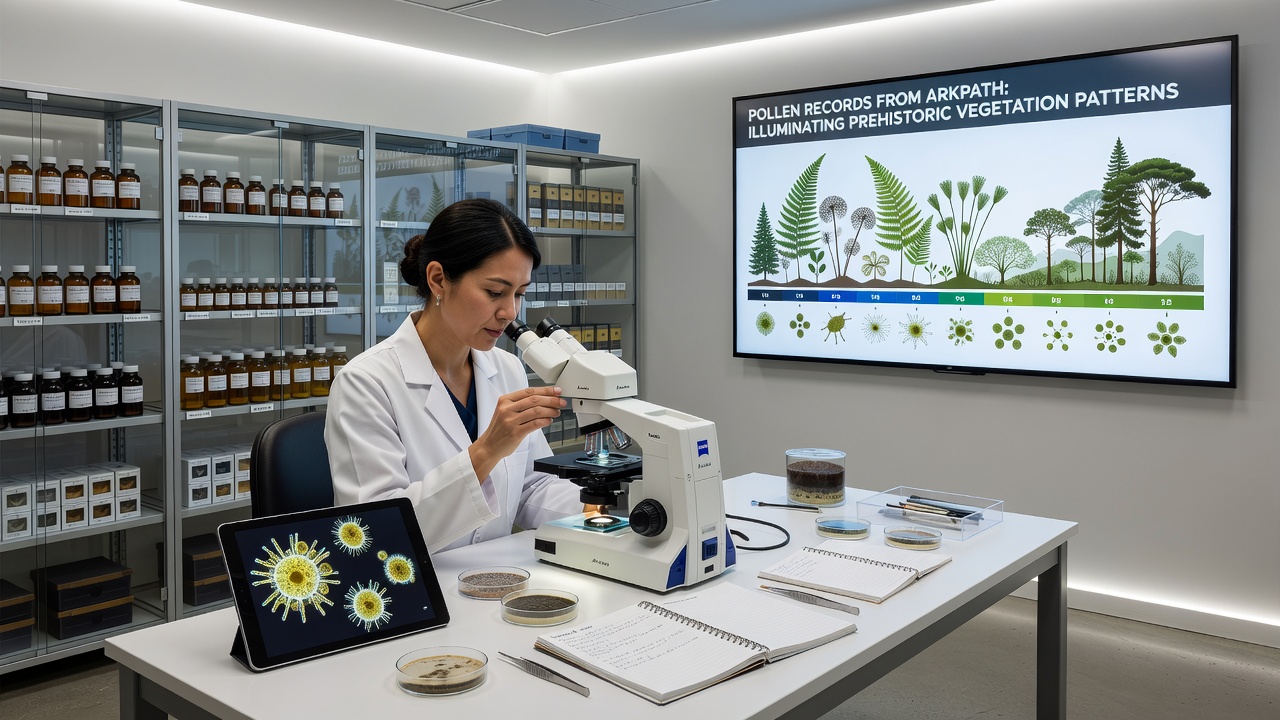
Further down the cores, earlier interstadial phases display brief peaks in temperate tree pollen that indicate short-lived warming events interrupting longer glacial stadials. These oscillations match patterns documented in Greenland ice cores, although the Arkpath sequence offers higher temporal resolution for the terrestrial vegetation response because sedimentation rates remained relatively steady.
Regional Comparisons and Data Integration
Comparisons with sequences from other European sites reveal both shared trends and site-specific variations, and Arkpath stands out for its continuous coverage through the Younger Dryas when many records show hiatuses. Collaborative databases compile these results so that spatial interpolations can reconstruct past biomes at continental scales, while Australian research programs apply similar techniques to Southern Hemisphere contexts for global synthesis. Additional integration comes from Canadian geological surveys that contribute northern latitude data to the same modeling efforts.
Quantitative reconstructions convert pollen percentages into estimates of past temperature and precipitation using transfer functions calibrated against modern surface samples. These models indicate that mean annual temperatures at Arkpath rose several degrees Celsius between the Last Glacial Maximum and the mid-Holocene optimum, with precipitation patterns shifting from continental to more maritime influences during the same interval.
Upcoming Developments in 2026
Expanded sampling campaigns planned through 2025 will add finer-resolution records from marginal zones around the main basin, and preliminary results from these efforts are slated for presentation in September 2026 at an international paleoenvironmental meeting. Updated age-depth models incorporating new accelerator mass spectrometry dates will refine the timing of vegetation transitions already identified in the existing cores.
Conclusion
The pollen archive at Arkpath continues to supply high-resolution evidence of prehistoric vegetation dynamics that complements other paleoclimate indicators across multiple regions. Ongoing laboratory work and field campaigns extend the temporal and spatial coverage, while integration with international datasets supports broader reconstructions of past ecosystems and their responses to climatic forcing.